


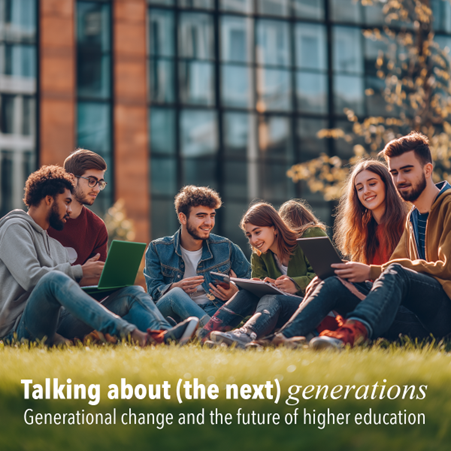
The landscape of higher education is undergoing a profound transformation driven by the unique socio-economic characteristics, learning expectations, and personal societal values of emerging generations (Deloitte, 2024; Giroux & Frey, 2024). I have recently published an ambitious and challenging scoping report entitled ‘A Horizon-Scanning Report on the Changing Demographic and Pedagogical Profiles of Current and Emerging University Students and the Responses of the Global Higher Education to the Generational Challenges’. This report commissioned by the N-TUTORR National Digital Leadership Network in Ireland, critically examines how generational shifts are reshaping higher education institutions (HEIs) and their strategic, pedagogical, and student experience decisions over the next decade. The report asks the question, what happens we go out of sync with our students? It looks at the changing demographic and pedagogical profiles of current and emerging university students and the responses of global higher education to the generational challenges of adapting our teaching, learning and assessment to adapt to a radically different learner (Rickles, 2009; Schnell-Peskin et al., 2023).
The report begins by exploring the characteristics and behaviours of three key generational cohorts entering or transitioning through higher education: Millennials, Generation Z, and Generation Alpha. Each of these generations brings distinct expectations and challenges to the higher education sector, necessitating a re-evaluation of traditional educational models and practices.
Millennials, born between 1981 and 1996, are characterised by their prioritisation of work-life balance and a view of education as a continuous journey rather than a finite achievement (Elam, et al., 2011). This generation favours experiential learning and values peer support over competition, particularly in postgraduate education (Chan & Lee, 2023). They are technologically savvy and urban-oriented, often facing economic challenges such as high housing costs and student debt. Millennials seek purpose-driven education and are heavily influenced by social media and peer feedback in their educational choices. Their desire for flexibility and adaptability in learning environments is a critical consideration for HEIs aiming to engage this cohort effectively (Deloitte, 2023).
Generation Z, born between 1997 and 2012, represents the most diverse generation in history with strong values around diversity, inclusion, and social justice. They demand flexible, technology-integrated learning approaches and are sceptical about the value of traditional degrees due to financial strain and employment uncertainties (Seemiller & Grace, 2016). This generation has a strong sense of social justice and expects their education to align with their values. Many Generation Z students are born into digital-first environments, having grown up with technology as an integral part of their lives, and they expect seamless integration of digital tools in their learning experiences (Mahesh, et al., 2021). Their engagement with technology and social media, coupled with a focus on career outcomes, drives demand for more practical and flexible approaches to higher education.
Generation Alpha, born since 2013, is anticipated to have high university participation rates, driven by their engagement with digital learning tools and social media and the high participation rate of their Millennial parents (Brain, 2022). This generation exhibits increased curiosity and individualism, shaped by global challenges and extensive exposure to AI and digital learning tools. Generation Alpha is growing up in a highly digital environment, familiar with mobile devices, virtual assistants, and AI from a young age. Their higher education experience is expected to blend traditional campuses with immersive digital experiences, adaptive learning platforms, and AI-assisted tutoring (Jukic & Skokjo, 2022). Teaching methods will likely need to emphasise practical skills development, project-based learning, and real-time collaboration across global networks.
I have identified several critical challenges for higher education institutions in adapting to these generational shifts focused on the pipeline into higher education as an experience, curriculum, teaching and learning delivery, assessment and strident belonging and community. One of the most pressing issues is student recruitment and retention. HEIs face unprecedented challenges in attracting and retaining students as these generations transition through the system. The financial stability of universities is frequently dependent on the design, provision, and completion of education for both undergraduate and postgraduate students. Declining participation rates, particularly in postgraduate programmes, pose a significant threat to the financial viability of many institutions.
Technological and pedagogical adaptation is another major challenge. Universities must adapt their educational delivery, support services, and value propositions to remain relevant and sustainable. This involves integrating digital tools and platforms into the learning experience, creating flexible and adaptable learning environments, and aligning educational offerings with the values and expectations of current and future students.
To address these challenges, I propose a reimagining of higher education across three reimagination horizons: programme/course design, lifelong learning, and spaces for innovation.


In terms of reimagining programme and course design, the report emphasises the need for HEIs to align their offerings with generational values and expectations. Programmes must tell a compelling story that includes impact, creativity, and inspiration, aligning with the values of work-life balance, flexibility, and sustainability. Curriculum design should integrate experiential learning, immediate feedback, and agile use of digital technology to meet the expectations of both undergraduate and postgraduate students. For Millennials, this means emphasising leadership development and flexible learning models. For Generation Z, it requires seamless technology integration and a focus on sustainability. For Generation Alpha, preparations should include highly personalised learning environments and AI-assisted education.
Reimagining lifelong learning provision, modes and disciplinary areas is critical. Traditional approaches to lifelong learning must evolve to include learning experiences that resonate past their initial gratification and generate and create a life-wide epistemic value (Bryant, 2023, 2024). This involves building modular, transferable skills that support adaptability and flexibility. Innovative learning models like micro-credentials and stackable qualifications are essential for meeting the needs of Millennials and Generation Z. These models offer accessibility and work-life integration potential, allowing students to engage in lifelong learning without the financial and time burdens associated with traditional postgraduate programmes.
The final area for reimagining is spaces for innovation. Universities need to create environments that support innovation, co-design, and collaboration among students, staff, and industry. This involves creating safe spaces for pedagogical innovation and engaging in radical co-design of educational experiences. The example here at the University of Sydney is our highly innovative CONNECTspace project which has transformed teaching and learning spaces to be organic, agential and immersive (Bryant, 2024). Engaging in radical co-design of educational experiences is necessary to adapt to the changing demographic, socio-economic, and attitudinal characteristics of future students. This requires challenging established teaching methods and embracing transformative change while building on past successes. Success depends on engaged leadership, resource allocation, and authentic collaboration with students, industry, and staff across disciplines.
I conclude the report by emphasising the importance of a holistic, adaptive strategy for higher education institutions. By embracing flexibility, sustainability, and authentic engagement, universities can thrive in the new educational landscape, preparing students to navigate an increasingly complex and unpredictable world. The path forward for higher education requires a holistic, adaptive strategy that considers and addresses the critical reimagination horizons of programme design, lifelong learning, and spaces for innovation. By addressing these recommendations, higher education institutions can better align with the needs and expectations of current and future generations, ensuring their relevance and sustainability in the evolving educational landscape.
I end the report with the following challenge:
The stakes are high. As alternative educational pathways proliferate and traditional degree models are questioned by both students and industry, HEIs must proactively demonstrate their relevance, value, and capacity for meaningful impact. By embracing flexibility, sustainability, and authentic engagement, universities can not only survive but thrive in this new educational landscape, preparing students to navigate an increasingly complex and unpredictable world.
You can download a copy of the full report here.
About the author


Associate Dean Education and Co-Director of the Co-Design Research Group


Leave a ReplyCancel reply