


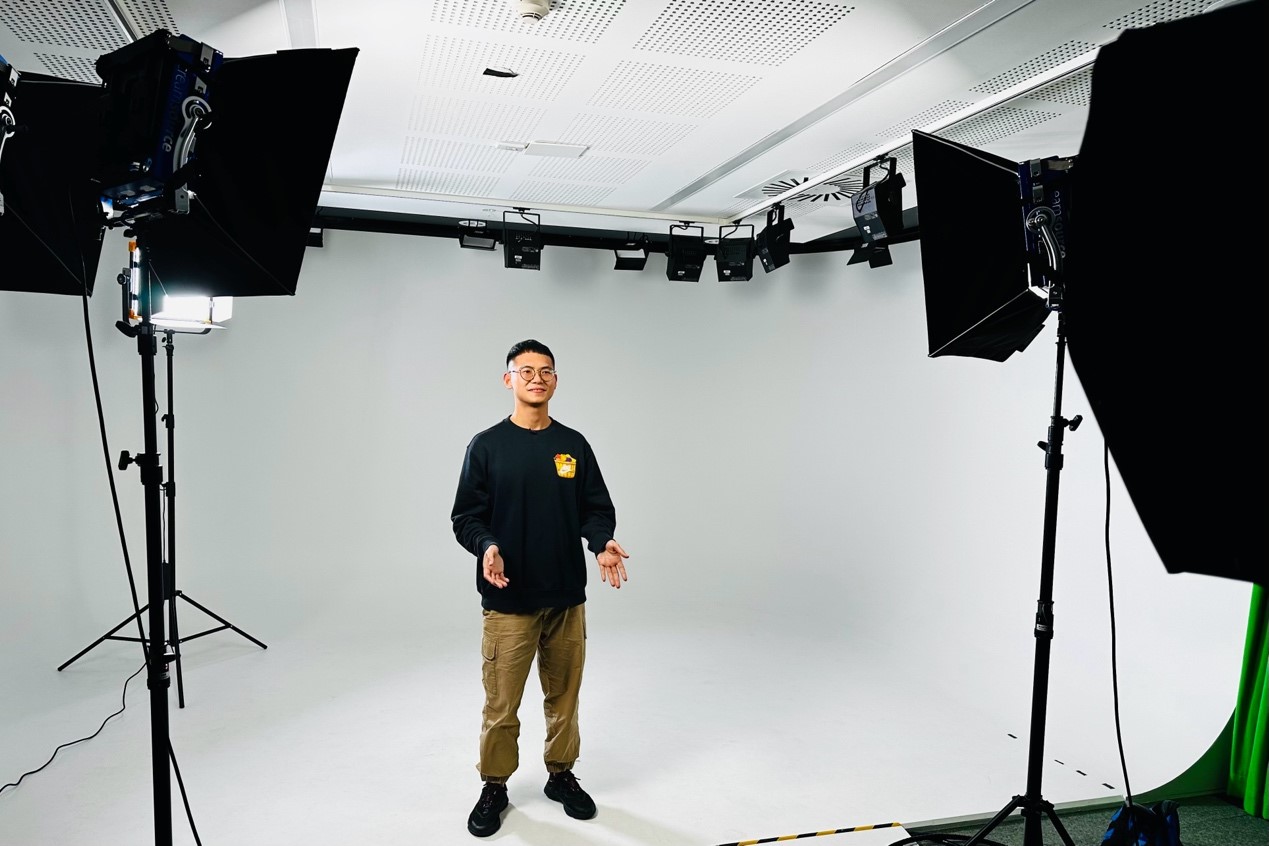
All my friends are surprised that I’m a student researcher at the Business School—they thought I was working on my PhD. My PhD focuses on student cooperation and use of Chinese social media during the pandemic. It explores how students supported each other, their response to the government’s call to action, their digital interaction and the reform of people’s thinking patterns and social norms. Yes, I’m an international PhD student from the Faculty of Arts and Social Sciences. My name is Qiyuan Hu, but my friends and colleagues love to call me Haley.
From Media and Communications to Business Education
Working as a Research Assistant (RA) for the Business School is an exciting opportunity. But, to be honest, on my first day rather than feeling excited, I was full of nerves, because research in education was a new area for me. I thought ‘How can a Media and Communications student nail this job?’
In 2022 I joined my first project, Work, Live, Play, Learn (WLPL). This is an annual research project run by the Business School where students are invited to share their insights about working and learning with friends, teachers and the wider community. Being a current university student made this feel relevant. I’ve been a university student since 2009, having started my undergraduate study in China. Then I came to Australia to pursue my Masters degree, and now I am doing my PhD. With this level of experience as a student, I should be a pro at this!

My role as a research assistant
I joined two research projects at the Business School: WLPL 2022 and another on authentic assessment in 2023. Students’ experiences were at the centre of both projects. Here, I needed to draw on my experience as a student to think about how to approach students, how to think like a student and position ourselves (the research team) in their shoes. This was crucial in designing research questions and considering ways of engaging student participation. This allowed me, as a student, to contribute my knowledge to the adjustment the research methods and interview questions. I was also able to draw on my experience and perspectives in the analysis and report writing later.
More than just data collection
Being a research assistant in these projects meant more than just helping with the literature review and data collection. This was the case, particularly for WLPL 2022 which seemed more like a group assignment. I cooperated with another student researcher. We discussed and designed an interactive activity together, in which we ran up and down the Abercrombie Building to recruit participants, and conducted the interview in our own style.
This doesn’t mean that we had no supervision. In fact, we sent our daily interview reports and met with the project manager regularly to discuss our progress and data. However, the project maximised our flexibility to steer the conversations with interviewees. This made it feel like a normal chat with friends after class.
I realised that student interviewees are not just subjects of this project that can only passively be studied; they are a at the centre of the project, telling us what we should focus on and the direction we should take. By bridging the gap between students and the project, we gathered more authentic, credible and accurate voices for the future development of the Business School.
Of course, facilitating data analysis was also an important part of the process. I can still remember the days we sat outside in the sun, grabbed a coffee, and talked about our findings in WLPL 2022. We found belonging is important to our students. This allowed me to resonate with the data and provide an international student perspective to the research team.
I could relate to many common themes: homesickness, culture shock, the language barrier, heavy study load, the feeling of disconnection, complicated interpersonal relationships, seeking financial support while enriching CV, etc. These are the real problems international student face, and I’ve been through. While studying overseas may be recognised as an admirable accomplishment in my hometown, there is a vast difference between the glossy surface and the reality of struggling alone. By adding my experience to the educators’ and university’s understanding, we successfully extracted and explored the themes: Peers, insecurity and loneliness, from these conversations (Menner et al., 2022).
Similarly, in the authentic assessment project, I was able to reflect on my experience of being a student in Australia and recall some of the comments from WLPL 2022. I discussed these themes with the manager, reflecting on how these expectations are catered to or otherwise missed due to the misconceptions of educators or unexpected factors in completing assignments.
I started understanding the meaning of ‘co-design’ throughout these projects. It’s not about a group of professional researchers locking themselves inside the office designing a fancy, complicated project to surprise outsiders by targeting serious, abstract issues. Instead, by inviting students to contribute with their authentic experiences, these projects can represent the true needs of Business students and are open to all possible directions of higher education development. In short, ‘co-design’, to me, is like a car. It engages academics and the management team as fundamental support and wheels, and students are the ones who fuel and lead where the car should go.
Co-design helps with future planning
I’m so thankful that I’ve had the opportunity to participate in these ‘co-design’ projects and can bring the students’ perspectives to the future development plan of the Business School. From this angle, ‘co-design’ provides a platform for students to engage in education. It doesn’t matter where you are from, and which subject you are doing. But it tries to emphasise that studying at university is not just about a student paying fees and studying, like a transaction, it is more about placing students at the centre, considering their on- and off-campus experiences as a whole and as a part of higher education, listening to their needs and adjusting the education plan to achieve higher student satisfaction.
Changes may happen slowly, but first things first, we students need to be heard and seen.
Leave a Reply Cancel reply